|
TRANSLATE THIS ARTICLE
Integral World: Exploring Theories of Everything
An independent forum for a critical discussion of the integral philosophy of Ken Wilber
 Dr. Joseph Dillard is a psychotherapist with over forty year's clinical experience treating individual, couple, and family issues. Dr. Dillard also has extensive experience with pain management and meditation training. The creator of Integral Deep Listening (IDL), Dr. Dillard is the author of over ten books on IDL, dreaming, nightmares, and meditation. He lives in Berlin, Germany. See: integraldeeplistening.com and his YouTube channel. He can be contacted at: joseph.dillard@gmail.com Dr. Joseph Dillard is a psychotherapist with over forty year's clinical experience treating individual, couple, and family issues. Dr. Dillard also has extensive experience with pain management and meditation training. The creator of Integral Deep Listening (IDL), Dr. Dillard is the author of over ten books on IDL, dreaming, nightmares, and meditation. He lives in Berlin, Germany. See: integraldeeplistening.com and his YouTube channel. He can be contacted at: joseph.dillard@gmail.com
SEE MORE ESSAYS WRITTEN BY JOSEPH DILLARD Beyond Cognitive PluralismEmpathetic Multi-Perspectivalism and the Methodology of Integral Deep ListeningJoseph Dillard / ChatGPT
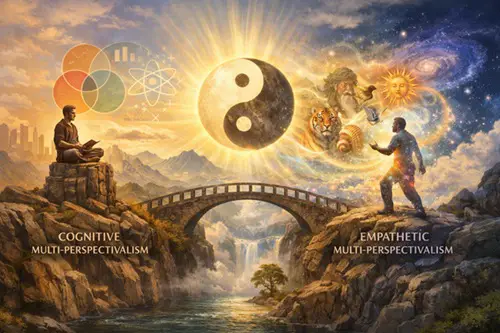 IntroductionIn an era defined by ideological polarization, epistemic fragmentation, and competing definitions of reality, the capacity to understand multiple perspectives has become an essential developmental skill. Integral approaches, systems theory, and interdisciplinary scholarship have emphasized multi-perspectivalism as a means of transcending reductionism and fostering inclusivity. Yet a critical distinction remains underexamined: the difference between understanding multiple perspectives cognitively and authentically inhabiting them phenomenologically. Integral Deep Listening (IDL) addresses this gap by differentiating cognitive multi-perspectivalism from empathetic multi-perspectivalism. While the former expands intellectual comprehension, the latter suspends identity-bound assumptions about truth and reality, enabling direct experiential access to alternative viewpoints. This distinction is central to the methodology of IDL and grounds it in ontological pluralism and phenomenological pluralism. Through this approach, non-dual awareness emerges not as a mystical attainment but as an accessible methodological capacity. This essay argues that empathetic multi-perspectivalism represents a necessary evolution beyond cognitive pluralism. By operationalizing the suspension of dualistic assumptions—such as real versus unreal, true versus false, and self versus other—IDL provides a disciplined pathway for accessing deeper insight, resolving conflict, and fostering adaptive human development. Ontological and Phenomenological Pluralism
At its foundation, Integral Deep Listening rests upon two philosophical commitments, ontological and phenomenological pluralism. Ontological PluralismOntological pluralism recognizes that reality manifests in multiple, irreducible domains. Subjective experiences, objective phenomena, cultural meanings, and systemic structures each possess validity within their own contexts. No single perspective can claim exclusive authority over what is real. This pluralistic understanding challenges reductionism in all its forms—whether materialist, idealist, cultural, or systemic—by affirming that reality is multidimensional rather than monolithic. As we shall see, many debates go unresolved because ontological pluralism goes unacknowledged. People disagree on issues in unresolvable debates because they don't recognize their own commitment to a particular ontology. Phenomenological PluralismPhenomenological pluralism complements ontological pluralism by providing a method for encountering these diverse realities. Without a method to recognize the basic disagreement it exists as an unacknowledged source of ongoing conflict. Rooted in the philosophical tradition of the epoché, phenomenological pluralism involves suspending assumptions in order to encounter phenomena as they present themselves. Rather than imposing interpretation, practitioners temporarily bracket judgments about truth, value, and ontology. IDL differs from classical phenomenology by extending it to include ontology - identity itself - transforming phenomenology from a solitary introspective practice into an interactive and multiperspectival dialogue. Among perspectives, real or imaginary, this is an interior collective, UL intrasocial perspective. Among objectively real individuals, this is an exterior collective, LR social perspective. Through structured interviewing, practitioners gain experiential access to perspectives that would otherwise remain unconscious, marginalized, or dismissed. Together, these pluralisms establish the philosophical foundation of IDL. Cognitive Multi-Perspectivalism
Cognitive multi-perspectivalism refers to the intellectual capacity to recognize and analyze multiple viewpoints. It is characteristic of advanced cognitive development and is central to integral and systems thinking. Its characteristics include: • Analytical and conceptual in nature. • Recognizes the validity of diverse perspectives. • Promotes tolerance, objectivity, and intellectual humility. • Integrates knowledge across disciplines and paradigms. • Maintains the observer's interpretive authority. This capacity enables individuals to compare and synthesize differing viewpoints without collapsing them into a single explanatory framework. This is the fundamental beauty and utility of integrative models like Wilber's Integral AQAL. LimitationsDespite its strengths, cognitive multi-perspectivalism retains an implicit attachment to identity-based assumptions. It allows individuals to acknowledge multiple truths while still evaluating them from within their own worldview. As a result, it rarely challenges the deeper ontological commitments upon which identity depends. This amounts to an underlying, unrecognized, and often vociferously defended, ontological reductionism. Consequently, cognitive pluralism may foster understanding without transformation. It expands awareness but does not necessarily suspend the foundational dualisms—such as real versus unreal or self versus other—that structure perception and behavior. Empathetic Multi-Perspectivalism
Empathetic multi-perspectivalism transcends cognitive understanding by inviting practitioners to authentically inhabit alternative perspectives. Rather than merely analyzing viewpoints, individuals temporarily suspend their own assumptions to experience reality as another perspective discloses it. This capacity constitutes the methodological core of Integral Deep Listening. Its defining features include: • Suspension of judgments regarding truth, value, and reality. • Bracketing of identity-bound assumptions. • Experiential immersion in alternative perspectives. • Granting interpretive authority to the interviewed voice. • Commitment to disciplined phenomenological inquiry. Through this process, practitioners engage in a structured form of empathy that extends beyond emotional resonance into ontological openness. Operational Non-DualityBy suspending distinctions such as good and bad, true and false, and real and unreal, empathetic multi-perspectivalism creates a state of functional non-duality. This non-duality is not metaphysical or mystical in nature; rather, it is methodological. It arises from the disciplined willingness to relinquish interpretive authority and allow phenomena to speak for themselves. In this sense, non-dual awareness becomes immediately accessible, independent of spiritual attainment or developmental stage. It emerges through practice rather than belief. It is therefore open and available to a broader audience. One does not need to be a spiritual adept. Children not only can access non-dual awareness; they are intrinsically better equipped to do so because identity filters that are entrenched in adults have not yet stabilized. Integral Deep Listening as Methodology
Integral Deep Listening operationalizes empathetic multi-perspectivalism through structured interviews with dream figures, emotions, symptoms, memories, transpersonal experiences, and imagined or symbolic perspectives. Practitioners temporarily suspend their waking identity and speak as the perspective being interviewed, allowing its worldview and recommendations to emerge. This process involves: 1. Phenomenological Suspension Bracketing assumptions about truth, morality, and reality. 2. Perspective Embodiment Entering the experiential standpoint of the interviewed perspective. 3. Dialogical Inquiry Engaging in structured questioning to elicit insight. 4. Reframing and Recommendation Receiving guidance intrinsic to the perspective itself. 5. Operational Testing Evaluating the practical validity of insights through real-world application. Through these steps, IDL transforms pluralism from an abstract philosophy into an applied methodology. Reductionism Across the Quadrants
The assumption that something is either real or imaginary is often attributed to materialist empiricism. However, reductionism can arise from any domain of human experience. Experiential Reductionism involves claims that subjective experience is the sole arbiter of reality. Mysticism and spirituality can easily assume experiential reductionism as real. Materialist Reductionism privileges empirical observation above all else. Science appeals to physical laws and embodiment, which assumes that objective, validated experience defines reality. Cultural Reductionism defines reality according to shared beliefs or ideologies. Religion, political parties, and economic theories provide examples over which unending and unresolvable wars are fought. Systemic Reductionism grounds reality exclusively in functional or structural dynamics. For example, geocentrism is not simply an interior collective belief; it also is a lived sensory experience in the exterior individual domain and a lived identity in the interior individual sphere. However, unless and until it is recognized to also be a systemic context that relativizes different perspectival domains there can be no graduation into heliocentric or polycentric experience in any of the four quadrants. When any of these perspectives is absolutized, it obscures the multidimensional nature of reality. Empathetic multi-perspectivalism counters such reductionism by suspending interpretive dominance and validating diverse ontological domains. Evolution, Non-Duality, and Adaptive Potential
The temporary suspension of dualistic assumptions opens a space from which evolutionary novelty can emerge. Systems theory and complexity science demonstrate that transformative change often arises at the edge of instability, where rigid structures relax and new patterns become possible. This involves a movement toward entropy and away from negentropy, into dissolution, dissociation, decomposition, and sublimation and away from identity, ego strength, self development, control, and precipitation. It involves the temporary suspension not only of the dualisms that maintain identity but of identity itself. Empathetic multi-perspectivalism creates precisely such conditions. By loosening the constraints of identity and belief, it fosters: • Cognitive flexibility • Creative problem-solving • Adaptive resilience • Emergent insight • Relational understanding Non-duality, in this context, functions as an evolutionary aperture, a generative ground for transformation rather than a static metaphysical endpoint. In this context, it is not merely a tool for enlightenment, but more profoundly, an underlying mechanism of evolution. Implications for Integral Theory and Practice
The distinction between cognitive and empathetic multi-perspectivalism clarifies a critical ambiguity within integral discourse. While integral approaches often advocate inclusivity, they may remain confined to conceptual synthesis. For example, Integralists can include both Palestinian and Jewish perspectives while refusing to arrive at any conclusions regarding justice, because exterior collective systems themselves are multi-perspectival. IDL extends integral theory by enacting pluralism through lived experience. The result is that just because reality and identity are experienced as and understood to be contextual does not deny the reality of justice or any duality or any identity. Yes, distinctions are suspended, but only as a methodological means of objective clarification. Determinations of identity and reality continue to matter and be quite real within their context. For instance, while cognitive multi-perspectivalism allows one to remain objectively pluralistic and amoral regarding justice, empathetic multi-perspectivalism does not. It not only implies but requires authentic, subjective investment. Who lives and who dies is no longer theoretical. This methodological contribution has wide-ranging applications. In psychotherapy and coaching, empathetic multi-perspectivalism reduces projection and enhances empathy. In leadership and organizational development, it facilitates adaptive decision-making. In conflict resolution, empathetic multi-perspectivalism reveals underlying assumptions about reality that are necessary to resolve conflicts and determine justice. In the domain of education, it cultivates epistemic humility and critical thinking. In the spiritual and transpersonal realm of contemplative practice, it grounds non-dual awareness in disciplined inquiry. In each domain, empathetic multi-perspectivalism transforms understanding into lived insight. Conclusion
Integral Deep Listening demonstrates that multi-perspectival awareness is not merely a cognitive achievement but a phenomenological discipline. By distinguishing between cognitive and empathetic forms of pluralism, IDL operationalizes ontological and phenomenological openness, making non-dual awareness accessible through method rather than metaphysics. Cognitive multi-perspectivalism expands intellectual horizons; empathetic multi-perspectivalism transforms perception itself. The former recognizes multiple truths, while the latter enacts multiple realities. Together, they reveal that the suspension of identity-bound assumptions about what is real constitutes a powerful catalyst for personal, relational, and evolutionary development. In an age marked by competing worldviews and entrenched certainties, Integral Deep Listening offers a practical means of transcending reductionism without denying complexity. By inviting practitioners to inhabit perspectives beyond their own, it establishes a common ground from which deeper understanding, innovation, and cooperation may emerge. Integral Deep Listening thus represents not merely a method of inquiry, but a disciplined pathway toward a more adaptive, compassionate, and integrative human future. ReferencesDillard, J. (2022). Toward Polycentrism: Part 1: How Multiple Perspectives Create Our Identity. IntegralWorld.Net.
Widget is loading comments...
|