|
TRANSLATE THIS ARTICLE
Integral World: Exploring Theories of Everything
An independent forum for a critical discussion of the integral philosophy of Ken Wilber
 Dr. Joseph Dillard is a psychotherapist with over forty year's clinical experience treating individual, couple, and family issues. Dr. Dillard also has extensive experience with pain management and meditation training. The creator of Integral Deep Listening (IDL), Dr. Dillard is the author of over ten books on IDL, dreaming, nightmares, and meditation. He lives in Berlin, Germany. See: integraldeeplistening.com and his YouTube channel. He can be contacted at: joseph.dillard@gmail.com Dr. Joseph Dillard is a psychotherapist with over forty year's clinical experience treating individual, couple, and family issues. Dr. Dillard also has extensive experience with pain management and meditation training. The creator of Integral Deep Listening (IDL), Dr. Dillard is the author of over ten books on IDL, dreaming, nightmares, and meditation. He lives in Berlin, Germany. See: integraldeeplistening.com and his YouTube channel. He can be contacted at: joseph.dillard@gmail.com
SEE MORE ESSAYS WRITTEN BY JOSEPH DILLARD Tibet: Separating Fact from FictionJoseph Dillard / ChatGPT
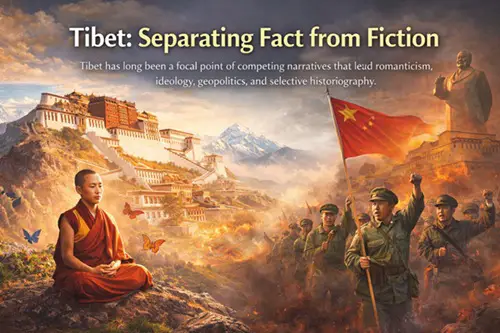 Tibet has long been a focal point of competing narratives that blend romanticism, ideology, geopolitics, and selective historiography. The “traditional Western political narrative” portrays pre-1950 Tibet as a peaceful, harmonious Buddhist utopia, ”Shangri-La,” isolated from modernity and brutally invaded by Communist China in 1950, with the 1959 Lhasa uprising and the Dalai Lama's exile marking the destruction of a non-violent theocracy through cultural erasure and human rights abuses, especially during the Cultural Revolution. This view, reinforced by figures like Heinrich Harrer in 'Seven Years in Tibet', frames the issue as a clear case of aggression against an innocent spiritual society. Scholars such as Donald S. Lopez Jr. critique it as an “Orientalist fantasy” ('Prisoners of Shangri-La') that ignores pre-1950 inequalities while sustaining exile advocacy. The “Wilber/New Age/spiritual narrative” overlaps substantially but elevates Tibet as a supreme repository of ancient esoteric wisdom. “Vajrayana” (tantric) Buddhism, with practices like Dzogchen, Mahamudra, dream yoga, and deity yoga, is seen as preserving the highest stages of consciousness evolution and non-duality. The Dalai Lama embodies compassion, as an emanation of Avalokitesvara, and universal ethics. Ken Wilber's Integral Theory draws explicitly on these traditions for its maps of states and stages of awareness, portraying pre-1959 Tibet as a spiritually advanced society threatened by materialism and communism. Emphasis falls on dharma preservation, Shambhala-like ideals, and the exile movement as a defense of sacred heritage rather than mere politics. The “Chinese narrative” inverts this picture. Tibet has been an “inseparable part” of China since the Yuan dynasty (or at least Qing suzerainty), with the 1652-1653 visit of the Fifth Dalai Lama to the Shunzhi Emperor cited as formal recognition of central authority via title and seal. Pre-1950 Tibet was a “dark” feudal serfdom: a tiny elite of less than 5%—aristocrats, officials, upper lamas, and monasteries, exploited more than 95% of the population as hereditary 'mi ser' (serfs) through corvée labor, crippling taxes, usury, and occasional mutilation. The system produced stagnation, near-total illiteracy, and poverty. China's 1950-51 “peaceful liberation,” via the Seventeen-Point Agreement, and 1959 “democratic reforms” emancipated the serfs, abolished theocracy, separated religion from state, and delivered modernization, infrastructure, education, healthcare, economic growth, and ethnic unity. Unrest is blamed on the “Dalai clique,” feudal remnants, or Western imperialists; the Dalai Lama is depicted as a former serf-owner seeking to restore privileges. Historical Record and Relationship with ChinaScholarly consensus, drawing on historians like Melvyn Goldstein, Tsering Shakya, and Robert Barnett, offers a more nuanced view that rejects both romantic idealization and propagandistic extremes. Pre-1959 Tibet was a "feudal theocracy" under the Dalai Lamas, which was Gelugpa dominant from the 17th century, with monasteries and nobles controlling most land and power. The mi ser'system involved hereditary bondage to estates, documented obligations of often heavy corvée labor, taxes that were frequently 50%+ of produce, and debt. Serfs had some personal rights, possessions, only limited mobility mechanisms, and legal recourse in practice, but the system was stratified and exploitative. Extreme abuses occurred but were not universal. Illiteracy exceeded 90-95%, life expectancy was as low as 35 years in some estimates, and the economy remained agrarian/pastoral and stagnant. Buddhist ethics shaped daily life, festivals, and merit-making, yet institutional realities often diverged from ideals. Politically, Tibet maintained complex ties with China/Mongols/Qing through “priest-patron” relationships and loose suzerainty, not direct provincial control. The foundational model began in the Yuan era with the Sakya school, which is not the Dalai Lama lineage. The Fifth Dalai Lama's Beijing visit in 1652-1653, marked by mutual respect rather than full kowtow, formalized a title and seal under the Qing, reflecting spiritual guidance for the emperor and secular patronage/protection for Tibetan Buddhism. Earlier Ming relations were looser and largely symbolic. After the 1912 Qing collapse, Tibet functioned with de facto independence, including Tibet's own government, currency, army, and limited foreign ties, until 1950, though without broad de jure recognition. The 1950 PLA entry into eastern Tibet, the 1951 Seventeen-Point Agreement, initial gradualism, mid-1950s radical reforms in Kham sparking Khampa revolts, the 1959 uprising, and full central control followed. The Cultural Revolution devastated monasteries. Post-Mao reforms delivered genuine material development alongside tight political control, surveillance, sinicization, cultural/linguistic restrictions, and demographic shifts. China's motives for the 1950s shift to direct control stemmed from post-1949 nation-building: territorial unification, strategic defense, with the high Tibetan plateau viewed as a southwestern buffer against India or “imperialists”, and Marxist ideology, which was seen as liberating feudal serfdom through socialist transformation. The Seventeen-Point Agreement was tactical, promising autonomy and religious protection while advancing toward centralized “national regional autonomy.” This marked a break from historical looseness. U.S. motives in the 1950s-60s were Cold War containment of communism. The CIA's Tibetan program, known as ST CIRCUS/Project Circus, formalized around 1958 under Eisenhower, supported Khampa resistance with training, arms drops, intelligence, and propaganda to harass Chinese forces, gather data on China, and sustain the idea of Tibetan autonomy. Subsidies to the exile administration, amounting to some $1.7 million annually in the 1960s, including $180,000 explicitly for the Dalai Lama's entourage and offices, aided lobbying and operations until termination in 1972-74 amid Nixon's rapprochement with China. Tibetan leaders, including the Dalai Lama's brother, sought this aid. It was not altruism but geopolitic strategy; the Dalai Lama remained publicly non-violent. Pre-1950s Life for the Average TibetanFor 90-95% of the Tibetan population, life was subsistence agrarian or pastoral under the Ganden Phodrang government. Serfs farmed barley or herded yaks on estates divided into lord's unpaid labor and family tenement plots. Obligations were heavy; there was no modern “average income” in a largely non-monetized economy. Most people lived at basic levels with little surplus. Government support was minimal. There was no welfare state, public education, or universal healthcare. The central administration, consisting of Dalai Lama and Kashag, set broad policy, but power was decentralized among aristocratic estates and powerful monasteries which owned some 37% of land and maintained influence and sometimes armies. The government was theocratic and monastery-influenced, with a hybrid lay/monk bureaucracy, yet monasteries were not the sole policy source. Mahayana/Vajrayana teachings stress compassion (karuna), non-duality, interdependence, and alleviating suffering. These permeated culture through devotion, rituals, and merit-making, providing meaning and cohesion. Monasteries offered charity, traditional medicine, and limited education that was mostly for monastics. Yet a gap existed: major monasteries were large landowners extracting labor and taxes from serfs, with elites enjoying relative luxury. Karma interpretations sometimes rationalized hierarchy. Individual benevolence coexisted with institutional stratification, which was common in pre-modern religious societies. Contemporary Tibet: Quality of Life and Religious FreedomPost-Mao reforms brought substantial material gains. Official Chinese statistics report dramatic improvements: life expectancy rose from about 35.5 years pre-1959 to 71-72.5 years by the early 2020s, with claims of 72.5 years recently. There exists near-universal basic education and healthcare access via a multi-level network. GDP per capita has reached US$10,600 in 2024, with disposable income growth and poverty elimination claims. Infrastructure, in the form of roads and railways has expanded connectivity. Independent assessments present a more mixed picture. Chinese sources emphasize restored monasteries and tourism as evidence of freedom, but independent observers note these operate under tight ideological oversight. In summary, pre-1950 Tibet was a poor, devout feudal theocracy with real inequalities and limited freedoms, not Shangri-La nor unrelenting hell. China's incorporation ended the old system and delivered modernization at the cost of autonomy and cultural self-determination. U.S. involvement was Cold War realpolitik that undoubtedly intensified the Chinese invasion and clamp-down on Tibet and Tibetans. Today, material living standards have risen markedly for many Tibetans, yet political control, surveillance, linguistic/cultural pressures, and limits on religious expression persist, creating a complex reality where economic gains coexist with profound restrictions on freedom and identity. Popular narratives on all sides often serve agendas more than they capture this nuance. ConclusionIn scholarly consensus (drawing heavily on Goldstein's fieldwork-based research), pre-1950s Tibet was a poor, conservative, devoutly Buddhist feudal theocracy with real inequalities and limited freedoms for the average person—not the romantic Shangri-La of Western myth, nor the unrelenting hellscape of some propaganda. Conditions varied by region, estate, and individual lord, with cultural and religious life providing cohesion amid material hardship. Wilber's Integral Theory explicitly draws on Tibetan Buddhism for its map of states/stages of consciousness and has endorsed works on preserving Vajrayana lineage wisdom into the modern era. The narrative emphasizes dharma preservation, Shambhala-like ideals, and critiques of Chinese rule as an assault on sacred heritage, often framing the Dalai Lama's exile movement in terms of universal spiritual values rather than purely political ones. While for Westerners who search for life meaning and sources of spiritual inspiration, classical Tibet is an important archetype of non-dual wisdom and compassion, it is likely that for the average Tibetan today freedom from feudal bondage, access to health care, to education for their children, and a greatly increased life expectancy are likely to be more important factors.
Widget is loading comments...
|