|
TRANSLATE THIS ARTICLE
Integral World: Exploring Theories of Everything
An independent forum for a critical discussion of the integral philosophy of Ken Wilber
 Dr. Joseph Dillard is a psychotherapist with over forty year's clinical experience treating individual, couple, and family issues. Dr. Dillard also has extensive experience with pain management and meditation training. The creator of Integral Deep Listening (IDL), Dr. Dillard is the author of over ten books on IDL, dreaming, nightmares, and meditation. He lives in Berlin, Germany. See: integraldeeplistening.com and his YouTube channel. He can be contacted at: joseph.dillard@gmail.com Dr. Joseph Dillard is a psychotherapist with over forty year's clinical experience treating individual, couple, and family issues. Dr. Dillard also has extensive experience with pain management and meditation training. The creator of Integral Deep Listening (IDL), Dr. Dillard is the author of over ten books on IDL, dreaming, nightmares, and meditation. He lives in Berlin, Germany. See: integraldeeplistening.com and his YouTube channel. He can be contacted at: joseph.dillard@gmail.com
SEE MORE ESSAYS WRITTEN BY JOSEPH DILLARD Iran: A major geopolitical shiftJoseph Dillard / ChatGPT
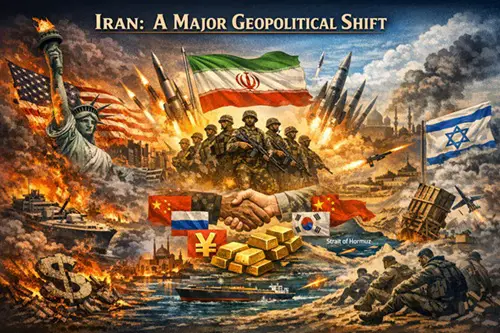 While events regarding the war move so fast it is difficult to make any assessment that is not immediately outdated, there are trend lines that predict events. The events that are currently unfolding in the Middle East are indeed momentous The movement away from support of the petrodollarJapan has now declared it is willing to buy Gulf oil in yuans, the Chinese currency, a basic demand of Iran for any passage through the Straits of Hormuz. This basically means that the US is in the process of losing petrodollar dominance, as Japan is the largest foreign holder of U.S. Treasuries, with approximately $1.22 trillion in holdings. South Korea and Indonesia appear to be negotiating similar terms with Iran. Trading in dollars has supported the ability to maintain debt that otherwise would be unsustainable. It is becoming much more difficult to continue to do that.[1] Food vulnerabilityThe Gulf states import almost all their food. They will run out in two weeks, as of the third week in March, 2026. To save the collapse of their economies they will have enormous pressure to regain import ability through the Straits. To do that they will have to meet Iranian demands. Those include not only denominating their purchases in yuan but, according to Iran, evict US bases and embassies.[2] The ability of Iran to repel attackMultiple well-connected sources have concluded that air bombardment, naval shelling, amphibious landings, or insertion of paratrooping forces into Iran are ineffective or disastrous strategies. The conclusion is that Iran is too well defended by a military structure that is decentralized. It cannot be decapitated. Even multiple nuclear strikes would be unlikely to destroy the capability of Iran to continue the war.[3] Continuing decline of support for IsraelAccording to multiple polls, US support for Israel and the war is rapidly declining. Without US support, Israel's continued existence becomes highly doubtful.[4] Depletion of US and Israeli defensesAs of this date, both the US and Israel have almost run out of missile and drone interceptors, which means that they are increasingly vulnerable to bombardment.[5] Deadly bombardments by Iran continueIran, by contrast, continues to bomb US bases in the Gulf states and also Israel at a rate of three volleys a day, with a total of 30-60 missiles. There is no indication that Iran is running out of missiles.[6] The sophistication and effectiveness of Iranian missilesAt least some Iranian missiles are maneuverable and move at several times the speed of sound. They have multiple independent warheads, meaning one missile can generate a huge amount of damage. They are very rarely shot down. This implies that Iran does not need nukes to destroy US bases or Israel. While Iran is the size of western Europe and decentralized, the Israeli population is centralized in only a few cities and US power in the Gulf is centralized in only a few bases. Iran has announced to its adversaries by launching missiles toward Diego Garcia in the Indian Ocean that it can attack opponent military assets over two thousand miles away. Iran continues to possess significant air defensesDespite the fact that Iran continues to be bombed by long range glide bombs and cruise missiles, the US and Israel cannot fly over Iran without risking getting shot down. Iran probably shot down a US F-35 stealth bomber that was supposed to be invisible. It is the most advanced plane in the US arsenal. This means that Iran continues to have at least some degree of air superiority over its own territory.[7] The non-traditional nature of Iranian defensesThe US says it has destroyed the Iranian air force and navy. The problem with that is that Iran's military is focused on three things: 1) its missile forces, which are formidable and clearly still functional, 2) its non-traditional naval force of underwater drones, torpedoes, etc. that cannot be easily interdicted, 3) its long-range artillery, far back from the coast, which can destroy any ship in the Straits, 4) its large and highly motivated army. There is no indication the US and Israel have significantly degraded any of these. The US possesses no minesweepers to clear mines from the Strait. The EU refuses to send theirs. The inability of nuclear attack to stop the ongoing demise of the petrodollarWhile Israel could indeed launch nukes on Iran from its submarines, with devastating effects, it is highly unlikely that this would either destroy Iran or open the Straits of Hormuz. If neither of those are likely results while Iran continues to force a global move from the dollar to the yuan, Iran will have accomplished a major global shift in economic power.[8] Logistical incapacityThe US lacks the logistics to sustain an attack on Iran, while Iran is receiving considerable military and economic support from both Russia and China. This will sustain Iran and there is little to nothing the US and Israel can do about that.[9] Greater motivation to fightFor Iran this is an existential threat. Iranians are willing to die in this war. Americans and Israelis? Not so much.[10] Fundamentally different strategiesThe US and Iran planned for a short war, which played to their strengths: decapitation and sowing internal chaos with Mossad agents and paid insurrectionists on the ground. What they got instead is a long war that they did not plan for with no end in sight.[11] Absence of military proxiesThe US and Israel have no proxies to do their fighting for them. Israel has relied on the US to be their proxy, sacrificing itself for reasons of greed , hubris, or religious zealotry. But US support for the war is low and declining. The US had hoped to bribe the Kurds into being their proxy, but the Kurds, having been betrayed by the US previously on multiple occasions and understanding the capabilities of Iran, have said no.[12] The negative impact of the war on US civiliansThe war is coming home to average Americans, not only in higher gas prices but in the eventual inflation of the costs of food and everything else that relies on petrol for delivery or fertilizer to grow. That the US is energy self-reliant does not shield it from the steadily escalating cost of a barrel of oil on the international markets.[13] The incapabilities of EuropeEurope has expended its military on Ukraine; it is highly dependent on the Gulf states for oil. The US is already making noises of stopping the export of gas. LNG, in order to stabilize its own markets. If it does that, Europe will not simply go into recession. It will go into depression. That will possibly be the end of both NATO and the EU.[14] Logistic issuesSustaining a war requires logistics, the ability to supply forces with the means to continue to fight. Both the US and Israel have severe logistic constraints. The threat of no waterWhile Iran gets about 2% of its water from desalination, that percentage is north of 50% for Israel and around 80% for the gulf monarchies. Iran is basically holding a gun to the resulting in a combination of mass emigration and/or civilian deaths. Collapse of the basic contractThe basic contract of the US and the Gulf monarchies since the end of WWII has been, “You support the petrodollar and buy our weapons and we will defend you.” However, the US has run out of missile and drone defense missiles, demonstrating its real limitations in its ability to defend the Gulf states. Unwillingness of Iran to agree to a truceIran views a truce as an opportunity for the US and Israel to rearm and attack again. Therefore, it has stated that it is not willing to stop the war until its demands are met. Those demands are completely unacceptable to the US and Israel. Potential for massive global blowback on IsraelIf Israel did use one or more nuclear weapon on Iran the consequences for Israel are highly unpredictable, but generally on a scale from terrible to disastrous. While the possibility of “The Sampson Doctrine,” in which Israel, out of a recognition it is defeated, attempts to destroy others with it, remains a possibility, it is becoming less so. Even a nuclear strike would not reopen the Strait of Hormuz, eliminate dispersed military capacity, restore economic systems like dollar dominance, or produce clean, decisive victory. The collapse of US, Israeli, and European narratives on the weight of their own internal contradictions.While those of Trump are obvious enough, as he contradicts his claims on a daily basis, first saying Iran is “obliterated” then saying that he needs 200 billion to continue the war, supportive logical fallacies by UK defense secretary Healy, Merz of Germany, and Macron of France can easily fortify the consistency of fundamentally false narratives, below the cognitive radar. However, the above patterns, combined with the rules of logic that undergird basic sense-making, penetrate the fog of war. It is now widely understood that Israel, the Zionists, and the US have profoundly underestimated the capabilities and persistence of Iran. Increasingly, due to the cutoff from Gulf energy, the world will be pressuring the US and Israel to stop. It seems that both the US and Israel now want a cease-fire but that they are unlikely to get one until they agree to Iran's terms. No one sees how it is politically possible for the US and Israel to agree to Iran's demands. The US and Israel appear to have gotten themselves into a war they now cannot get out of. This continues to be a very dangerous situation. Likely destinationsWhile no individual or nation lasts forever, multiple factors predict longevity. While national collapse is rarely a sudden occurrence, we can look at trend lines to make predictions about what nations are on the ascent and which are on the descent. Based on the information I have seen, China, Russia, and Iran are on the ascent. Israel, Europe, and even the United States are on the descent. These trends are likely to continue regardless of the outcome of the Iranian war.[15] ConclusionA common response to prediction based on patterns is to nit-pick with counterfactuals. One can always distract from pre-eminent conditions by focusing on limitations or alternative possibilities. At some point, generally in the future, it is understood that such arguments boil down to the equivalent of “But the world could have been created in seven days.” The wild card regarding any predictions regarding the outcome of the war is what Professor John Mearsheimer calls the “escalation ladder,” in which every aggressive act is met by a reciprocal one by the other side. At this point in time, while there are signs both the US and Israel are looking for a way to stop the war, escalation continues. While the above patterns point clearly to a likely eventual outcome of Iran continuing to be the dominant power in the middle east and global power shifting to Eurasia, all indications are that things are going to get worse before they get better. How much worse is unknown. Nuking Iran, as horrible as that would be, is not going to change the inertia behind all of the above factors, but it could still happen, for a number of reasons. Launching nuclear weapons could be a last desperate attempt to stop Iranian attacks. True Believers might believe that a nuclear war would hasten the coming of the Messiah and the building of the Third Temple, and their ideology could win out over cooler military heads in Israel and the US.
NOTES
Comment Form is loading comments...
|