|
TRANSLATE THIS ARTICLE
Integral World: Exploring Theories of Everything
An independent forum for a critical discussion of the integral philosophy of Ken Wilber
 Dr. Joseph Dillard is a psychotherapist with over forty year's clinical experience treating individual, couple, and family issues. Dr. Dillard also has extensive experience with pain management and meditation training. The creator of Integral Deep Listening (IDL), Dr. Dillard is the author of over ten books on IDL, dreaming, nightmares, and meditation. He lives in Berlin, Germany. See: integraldeeplistening.com and his YouTube channel. He can be contacted at: joseph.dillard@gmail.com
SEE MORE ESSAYS WRITTEN BY JOSEPH DILLARD
Addressing the Unthinkable:
Nuclear War
Joseph Dillard / ChatGPT
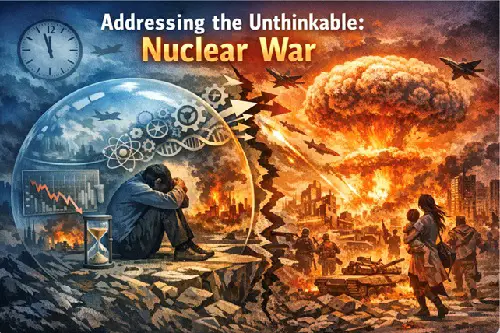
The question therefore arises: is nuclear war the next step in the escalation of modern conflict?
In psychology there is a well-known cognitive distortion called catastrophic expectation. It refers to the tendency to imagine worst-case outcomes and then avoid thinking about them because they are frightening. Ironically, avoidance often makes the problem worse. When fears remain unexamined, they quietly shape decisions and behavior.
Therapy addresses catastrophic expectations by bringing them into the open. Once confronted, they can be evaluated realistically. Often they prove exaggerated and lose their emotional power. In other cases, such as facing terminal illness, the threat is real, but looking at it directly allows people to understand their fear and respond to it consciously rather than reactively.
This principle applies not only to individuals but to civilizations. A modest willingness to consider worst-case outcomes can create greater stability, because it reduces both fear and blindness.
Today humanity faces such a possibility. The escalating confrontation between the West and Iran, within a broader geopolitical struggle involving Russia and China, raises a scenario that until recently was almost unthinkable: a nuclear conflict that could escalate beyond control.
Regardless of how likely we believe that outcome to be, it is clearly a catastrophic possibility. To refuse to examine it soberly would be an abdication of responsibility, not only to ourselves but to future generations.
To approach this question responsibly, we can step outside immediate political narratives and examine the situation through broader scientific frameworks: evolutionary theory, systems theory, and complexity science.
Evolution and the Balance of Order and Disintegration
Evolution is not simply a process of growth. It is a dynamic balance between structure and reorganization. On one side, adaptive structures emerge, stable patterns called attractors. These are the enduring forms we recognize as atoms, organisms, ecosystems, institutions, and civilizations. On the other side, systems periodically loosen or dissolve their existing structures in order to reorganize. In complex systems theory this movement toward temporary disorder occurs near the edge of chaos, where rigid patterns relax enough to adapt to changing conditions.
A familiar biological example is the daily cycle of waking and sleeping. During sleep the brain partially disintegrates waking structures of awareness. Synaptic weights are down-scaled, memories reorganized, and cognitive flexibility restored. Without sleep, cognition deteriorates, emotional regulation collapses, and hallucinations eventually appear. Even the human brain must periodically relax its structures in order to remain healthy. Civilizations appear to follow a similar rhythm.
Complexification: The Price of Evolution
Evolution produces increasing complexity. As matter organizes itself under energy flows, it develops new adaptive capacities: movement, metabolism, intelligence, and culture. Human societies mirror this process. Energy inputs, from coal and oil to nuclear and solar power, have allowed societies to grow in scale and complexity. Economic systems, technological infrastructures, financial networks, and global supply chains represent enormous adaptive achievements. But complexity has a cost. Growth and complexity are inseparable. Complexity is the price we pay for development, innovation, and civilization itself.
Does Complexity Increase Fragility?
Research in complexity science strongly suggests that it does. In The Collapse of Complex Societies, anthropologist Joseph Tainter argues that societies solve problems by adding layers of complexity, bureaucracy, infrastructure, technological systems. Over time these additions yield diminishing returns. When stress eventually arrives, the system can no longer sustain its overhead.
Complex systems also tend toward critical states, where small disturbances can trigger cascading failures. The classic example is a sandpile: grains accumulate gradually until a single additional grain produces an avalanche. Modern geopolitical and financial systems share similar characteristics. Nuclear deterrence networks, global markets, and military alliances are extraordinarily complex, and therefore potentially fragile.
Civilizations, like ecosystems, often require periodic disruption in order to reorganize. Economist Joseph Schumpeter called this process creative destruction. Evolutionary biologists speak of punctuated equilibrium. In each case, periods of stability are interrupted by phases of restructuring.
Path Dependence and Institutional Rigidity
Another feature of complex systems is path dependence. Early successes lock systems into trajectories that later become difficult to change. The QWERTY keyboard is a famous example. Although more efficient layouts exist, the enormous cost of retraining users keeps the system in place.
Societies exhibit similar inertia. Energy systems built around fossil fuels, Cold War security architectures, and global financial arrangements all demonstrate how entrenched structures resist change, even when the need for adaptation becomes obvious. Institutions that once solved problems gradually develop incentives to preserve themselves, even when circumstances change. Bureaucratic investment, ideological commitment, and internal power hierarchies reinforce rigidity.
Historically, dominant powers rarely relinquish influence voluntarily. Portuguese, Spanish, Dutch, and British empires all resisted decline until external pressures forced change. Human identity structures, both personal and collective, are notoriously resistant to adaptation.
Identity Fixation and Escalation
Political psychology shows that identity fusion can override rational cost-benefit calculations. When policies become tied to national pride, ideological identity, or moral narratives, compromise can feel like humiliation. Honor cultures, revolutionary regimes, and religious nationalisms frequently exhibit this dynamic. Once identity and policy fuse, backing down becomes psychologically impossible, even when escalation becomes self-destructive. This produces what strategists call escalation traps. A vivid example of this is current European expression of outrage at the US reduction of sanctions on Russian oil exports, even when the European economy itself is in grave danger due to the reduction of global oil flows to it.
Complex Systems in a Moment of Strain
Today humanity's adaptive achievements have produced unprecedented complexity. Artificial intelligence, global communication networks, financial interdependence, and advanced weapons systems have expanded human capability enormously. At the same time, these developments have increased systemic fragility.
Traditional moral constraints on warfare appear to be eroding. The bombing of civilian infrastructure and the normalization of mass casualties no longer produce the universal outrage they once did. Images of destroyed cities and dead children circulate so frequently that societies risk becoming desensitized.
If moral restraints weaken while technological power increases, the consequences could be catastrophic. The question therefore arises: is nuclear war the next step in the escalation of modern conflict?
The Evolutionary Paradox
A fundamental paradox emerges: Success produces rigidity. Rigidity produces collapse. Complex systems face a dilemma. If they adapt too slowly, they collapse under new pressures. If they change too rapidly, they destabilize themselves. Civilizations therefore oscillate between periods of order, disruption, and reorganization, mirroring the dynamics observed in complex systems across nature.
This same dynamic may help explain why an estimated 99% of all species that have ever lived are now extinct. Adaptation eventually outruns the capacity for further adaptation.
The Present Danger
The current geopolitical situation illustrates this paradox in real time. If conflicts involving Iran, Israel, the United States, and other powers continue to escalate, strategic planners may begin considering options that were previously unthinkable, including the limited use of nuclear weapons.
Military strategists sometimes speak of “demonstration” or “tactical” nuclear strikes designed to compel adversaries to concede. But history suggests that once such thresholds are crossed, escalation becomes extremely difficult to control. These possibilities, once confined to theoretical debates, are now being discussed seriously in strategic circles. Ignoring them will not make them disappear.
A Failure of Adaptation
The deeper issue may not be geopolitical rivalry alone. It may be a broader failure of adaptive capacity. As systems grow more complex, they often become less able to revise the assumptions on which they are built. Institutions defend their identities rather than adapt to changing realities. Empires rarely collapse solely because of external enemies. More often they collapse because their internal structures can no longer adjust. As the cartoonist Walt Kelly famously wrote: “We have met the enemy and he is us.”
Possible Paths Forward
If humanity is to avoid catastrophic escalation, solutions must operate at the level of systems rather than individual conflicts. Several possibilities exist:
• Multipolar balance, preventing any single power from dominating global systems
• Institutional renewal mechanisms, allowing periodic restructuring rather than rigid preservation
• distributed global governance, addressing shared risks such as nuclear weapons, climate change, and emerging technologies
• cultural adaptation, fostering norms that value restraint and strategic patience
These solutions are difficult but not impossible. History shows that geopolitical systems can transform through gradual internal change. The problem is in our current speed of species cultural and social change. It is clearly outstripping the speed at which both our biology and cognitive wiring adapt.
A Psychological Dimension
Ultimately, the problem may be psychological. Many conflicts arise from psychological geocentrism, the tendency of identities to place themselves at the center of reality. From this perspective, genuine adaptation requires something deeper than restraint or self-control. It requires the temporary suspension of rigid identity positions in order to allow new perspectives to emerge.
My work, Integral Deep Listening (IDL), calls this process “selfless reorganization”: a willingness to set aside entrenched identity long enough for reciprocity and mutual recognition to occur. Without such processes, systems become trapped within their own attractor basins, unable to evolve even when survival depends on it.
The Question Before Humanity
Modern civilization possesses extraordinary intelligence, technological sophistication, and capacity for cooperation. Yet it also tolerates wars of choice, mass suffering, and the normalization of violence. This contradiction raises an uncomfortable question.
If humanity cannot regulate its own destructive impulses despite possessing the knowledge and power to do so, can it sustain its own survival?
Thinkers such as Reinhold Niebuhr, Arnold Toynbee, Carl Jung, and Hannah Arendt all arrived at similar conclusions: civilizations endure only when power is balanced by restraint. When restraint disappears, collapse becomes probable.
Facing Our Own Cognitive Biases
Human beings possess cognitive biases that make existential threats difficult to perceive. We respond strongly to immediate inconveniences, such as rising fuel prices, while remaining relatively indifferent to distant tragedies. These biases can be exploited politically and socially. They allow catastrophic risks to grow quietly while public attention focuses elsewhere. Recognizing these biases may be one of the few aspects of the problem that lies directly within our control.
The Sword of Damocles
Humanity now lives under a technological Sword of Damocles. Nuclear weapons give our species the capacity to destroy itself. Whether we will outgrow the psychological patterns that make such destruction possible remains uncertain. But refusing to examine the possibility guarantees only one thing: that decisions will be made blindly. To confront catastrophic possibilities is not pessimism. It is responsibility.
|