|
TRANSLATE THIS ARTICLE
Integral World: Exploring Theories of Everything
An independent forum for a critical discussion of the integral philosophy of Ken Wilber
 Dr. Joseph Dillard is a psychotherapist with over forty year's clinical experience treating individual, couple, and family issues. Dr. Dillard also has extensive experience with pain management and meditation training. The creator of Integral Deep Listening (IDL), Dr. Dillard is the author of over ten books on IDL, dreaming, nightmares, and meditation. He lives in Berlin, Germany. See: integraldeeplistening.com and his YouTube channel. He can be contacted at: [email protected] Dr. Joseph Dillard is a psychotherapist with over forty year's clinical experience treating individual, couple, and family issues. Dr. Dillard also has extensive experience with pain management and meditation training. The creator of Integral Deep Listening (IDL), Dr. Dillard is the author of over ten books on IDL, dreaming, nightmares, and meditation. He lives in Berlin, Germany. See: integraldeeplistening.com and his YouTube channel. He can be contacted at: [email protected]
SEE MORE ESSAYS WRITTEN BY JOSEPH DILLARD Why Civilizations SurviveThe Four Relational Principles of EvolutionJoseph Dillard / ChatGPT
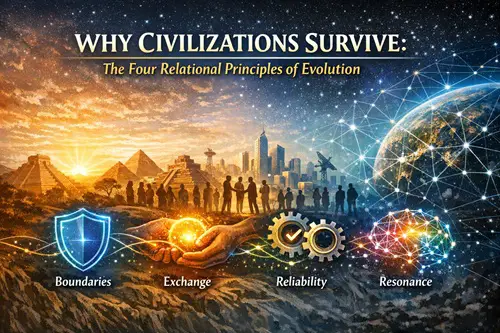 This essay proposes that healthy biological, social, and geopolitical systems all depend on a balance between survival and four relational capacities: boundaries, exchange, reliability, and resonance. Scientists like Lynn Margulis have demonstrated conclusively that evolution is not only about competition but also about symbiosis and systemic integration. As Margulis famously said, “Life did not take over the globe by combat, but by networking.” Ilya Prigogine has shown via far-from-equilibrium thermodynamics that complex systems organize themselves when energy flows through them. We know that evolution involves two simultaneous pressures, survival and relational. Due to survival pressure, entities maintain their integrity. Boundaries must be defended. Due to relational pressure, entities exchange energy, matter, and information. Systems integrate into larger systems. Every successful biological system balances these two forces.
The pattern repeats across scales. This insight aligns with systems thinking and complexity theory. In the domain of “relational exchanges,” that balance competition/survival priorities, I identify four elements underlying symbiosis:
Boundaries exist because systems must maintain identity and autonomy. Without boundaries organisms dissolve and societies lose coherence. Exchange, or reciprocity exists because adaptive systems exchange energy, resources, and information. Exchange can be material, in the form of energy or resources, or it can be informational in the form of signals and communication. Isolation leads to stagnation. Reliability (Trust) exists because stable systems require predictable interactions. Unpredictable actors destabilize networks. Examples include contract enforcement, rule of law, and diplomatic credibility. Resonance (Recognition of the Other) exists because systems must detect and respond to external signals. Resonance refers to the capacity of systems to perceive and respond to signals from others. In biology this includes chemical signaling and feedback loops. In human societies it appears as empathy or strategic awareness. These four principles resemble the fundamental properties of complex adaptive systems. Evolution Operates Primarily on PopulationsEvolution does not select primarily for individual success, but for population-level patterns. Traits survive only if they stabilize group-level dynamics. Examples include social insects, herd animals, and human societies. Human narratives about individual success often obscure this systemic reality. Applying This Model to GeopoliticsComplex systems exhibit similar structural dynamics across scales. The same principles governing cellular metabolism and ecological exchange often reappear in social systems, economic networks, and geopolitical alliances. Societies that balance survival and relational exchange are more likely to endure. This claim is consistent with historical observations. Stable civilizations tend to maintain internal cooperation, build external exchange networks, and preserve institutional trust. Examples include: long-lived trading civilizations, maritime commercial systems, and federated political structures. When these mechanisms collapse, societies often destabilize. The Evolutionary Failure PatternSuccessful systems become rigid because the structures that once produced success become entrenched. In complex systems terms this resembles path dependence or lock-in. Examples historically include late Roman imperial structures, rigid centralized empires, and financial oligarchies. Over-adaptation leads to loss of flexibility. When environmental conditions change, the system cannot reorganize. The Role of Short-Term SuccessStrategies that maximize short-term survival often undermine long-term adaptability. Examples include the overexploitation of resources, excessive centralization of power, and debt structures that hollow out productive capacity. In evolutionary terms, these strategies increase immediate fitness but reduce long-term resilience. All major powers attempt to balance security, economic integration, internal legitimacy. Failures occur when this balance collapses. Historical examples include imperial overstretch, elite capture of economic systems, and loss of institutional trust. We know that civilizations collapse when they undermine the relational exchanges that sustain complex systems. Those exchanges include economic reciprocity, institutional reliability, diplomatic credibility, and cultural recognition. When these break down, systemic trust erodes. Complex systems then fragment.While these failures appear across civilizations, what mostly matters to us is when these factors appear in our own society and civilization. While I could generate an enormous and growing list, I suspect you could too. Also, stating specifics tends to generate counter-examples that lose the forest for the trees. The real issue is not to what extent collapse is occurring or even what is causing it, but what can be done to slow it down or reverse it. A great deal is already known about what not to do as well as many steps that can and should be taken to improve the situation. What is less understood is the depth of resistance to change and how to deal with it. Implications for the FutureFrom an evolutionary systems perspective, the long-term success of societies will likely depend on their ability to maintain adaptive institutions, trust networks, balanced autonomy and interdependence, and learning capacity. Systems must be capable of self-reorganization. Economic and diplomatic reliability stabilizes global systems. Excessive isolation or excessive dependence both create vulnerability. Societies must incorporate feedback rather than suppress it. These principles apply regardless of ideology or civilization. Civilizations survive not merely by power but by sustaining the relational exchanges that allow complex systems to function. These exchanges include respecting boundaries, maintaining reciprocity, honoring commitments, and recognizing the autonomy of others. These dynamics are observable in many contemporary societies, including Western systems. In biological systems these principles appear automatically. In human societies they must be institutionally maintained. When institutions fail to support them, civilizations become unstable and are at increasing risk of disintegration. From an evolutionary systems perspective, the long-term success of societies will likely depend on their ability to maintain adaptive institutions, trust networks, balanced autonomy and interdependence, and learning capacity. Systems must be capable of self-reorganization. Economic and diplomatic reliability stabilizes global systems. Excessive isolation or excessive dependence both create vulnerability. Societies must incorporate feedback rather than suppress it. These principles apply regardless of ideology or civilization. Civilizations survive not merely by power but by sustaining the relational exchanges that allow complex systems to function. These exchanges include respecting boundaries, maintaining reciprocity, honoring commitments, and recognizing the autonomy of others. These dynamics are observable in many contemporary societies, including Western systems. In biological systems these principles appear automatically. In human societies they must be institutionally maintained. When institutions fail to support them, civilizations become unstable and are at increasing risk of disintegration.
Comment Form is loading comments...
|