|
TRANSLATE THIS ARTICLE
Integral World: Exploring Theories of Everything
An independent forum for a critical discussion of the integral philosophy of Ken Wilber
 Dr. Joseph Dillard is a psychotherapist with over forty year's clinical experience treating individual, couple, and family issues. Dr. Dillard also has extensive experience with pain management and meditation training. The creator of Integral Deep Listening (IDL), Dr. Dillard is the author of over ten books on IDL, dreaming, nightmares, and meditation. He lives in Berlin, Germany. See: integraldeeplistening.com and his YouTube channel. He can be contacted at: joseph.dillard@gmail.com Dr. Joseph Dillard is a psychotherapist with over forty year's clinical experience treating individual, couple, and family issues. Dr. Dillard also has extensive experience with pain management and meditation training. The creator of Integral Deep Listening (IDL), Dr. Dillard is the author of over ten books on IDL, dreaming, nightmares, and meditation. He lives in Berlin, Germany. See: integraldeeplistening.com and his YouTube channel. He can be contacted at: joseph.dillard@gmail.com
SEE MORE ESSAYS WRITTEN BY JOSEPH DILLARD "Peace in Our Time"Appeasement, Liberalism, and the Limits of Integral UniversalismJoseph Dillard / ChatGPT
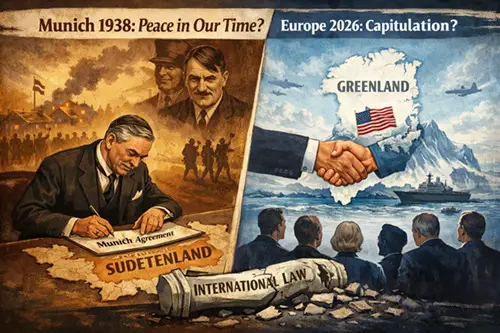 The Many Strengths of Integral LiberalismIntegral Theory has incorporated many concepts from Indian philosophical and contemplative traditions, particularly Hinduism and Buddhism. Yet structurally and normatively, it remains grounded in the Western liberal tradition extending from Plato through the Enlightenment and into modernity. At its core, AQAL reflects liberal universalism: the belief that diverse domains of life can be systematically understood within a single, coherent framework that claims cross-cultural validity while remaining open to critique and revision. This mirrors the liberal project itself, human rights, constitutional governance, international law, and scientific rationality, each asserting universality while presenting itself as corrigible and inclusive. This inheritance is not incidental. Liberalism begins with the individual as the primary unit of moral concern, and AQAL preserves this orientation in decisive ways. The Upper-Left quadrant, emphasizing individual interiority, meaning, intention, and consciousness, is treated as irreducible. Developmental trajectories are largely traced through individual cognitive, moral, and spiritual growth, from egocentric to worldcentric to kosmocentric. AQAL thus reflects a liberal pluralist hierarchy: inclusion and tolerance are central values, yet regression, absolutism, and exclusion are normatively criticized. Like liberalism itself, Integral presupposes developmental progress, greater complexity, perspective-taking, and integration, whether framed historically, evolutionarily, or spiritually. A further defining feature of liberal modernity is the differentiation of domains. Science is not morality; morality is not politics; politics is not religion. AQAL formalizes this differentiation through its four quadrants: • Objective truth (UR) • Subjective sincerity (UL) • Cultural meaning and ethics (LL) • Social systems and power (LR) This recapitulates Max Weber's differentiation of value spheres. Wilber's insistence that pathology arises from category errors, such as reducing consciousness to brain chemistry, or from what Alderman calls “violations of registries,” is a distinctly liberal-modern critique. Integral does not dissolve differentiation; it seeks to coordinate it. Wilber's moral arc, from egocentric to ethnocentric to worldcentric, closely aligns with liberal moral philosophy: the expansion of moral concern beyond tribe, nation, or religion; the emphasis on empathy, fairness, and universal dignity; and the rejection of coercion as a legitimate moral foundation. Even when Integral gestures toward post-liberal or post-modern ethics, its normative baseline remains liberal: pluralism, human rights, and procedural fairness. AQAL also exemplifies a liberal compromise with spirituality. It affirms contemplative traditions while rejecting religious authority, dogma, or theocracy. Spiritual insight is validated through experience, practice, and intersubjective corroboration rather than revelation. This mirrors liberalism's attempt to privatize spirituality while preserving public reason as secular and procedural. Integral's appeal lies partly in its functionality. It offers a meta-map applicable to education, therapy, leadership, sustainability, and governance. Problems are approached as complex systems to be integrated and optimized. The Integral practitioner often resembles a benevolent, systems-literate liberal technocrat. This accounts for Integral's appeal within NGOs, consulting, therapy, and policy discourse, but it also exposes it to critiques of elitism and managerial abstraction. Western liberalism has achieved genuine global influence. Democracy, human rights, international law, pluralism, and empiricism have become near-universal reference points, even where imperfectly realized. That adoption testifies to liberalism's enduring value. Yet both liberalism and Integral encounter serious difficulties when they adhere rigidly to their own ideals despite mounting evidence that those ideals are being selectively applied, strategically suspended, or rendered unenforceable by shifting power relations. Within Integral theory, Wilber's continued insistence on teleological evolution, despite overwhelming empirical evidence that biological evolution is not goal-directed, has weakened AQAL's credibility within scientific and policy-relevant domains. This does not negate AQAL's spiritual or heuristic value, but it does undermine its claim to offer a universally credible meta-framework across registries it purports to integrate. The Erosion of Western LiberalismA parallel credibility crisis confronts Western liberalism itself. The West's repeated violations of human rights, international law, and democratic principles, historical and contemporary, have eroded its moral authority, not only globally but increasingly among its own citizens. This erosion is no longer deniable. Since 2014 and Russia's annexation of Crimea, Europe and the broader liberal West have insisted, correctly, that international law and state sovereignty are inviolable. These principles have been treated as foundational to a rules-based international order. The question, then, is not whether those principles are valid, but whether they are enforceable when power relations shift. The emerging crisis over Greenland forces this question into the open. Greenland is part of Denmark, a sovereign European state and NATO member. Any attempt by the United States to annex or coerce control over Greenland, whether framed as purchase, security necessity, or alliance management, would constitute a violation of sovereignty and international law. The critical issue is not intent but structure: coercion exercised under overwhelming asymmetry. Europe's likely capitulation in this matter does not stem from moral confusion but from structural dependency. Europe has made itself economically dependent on U.S. energy, militarily dependent on U.S. security guarantees, and strategically dependent on U.S. leadership within NATO. These dependencies were not imposed; they were chosen. The consequence is diminished enforcement capacity. An Alarming PrecedentThis is where the comparison to Munich becomes historically instructive, not as a moral equivalence, and certainly not as a claim that contemporary American leaders are Nazis, but as a structural analogy. In 1938, Britain and France were formally powerful but materially exhausted, economically strained, militarily unprepared, and politically divided. Germany was a revisionist power pressing claims from a position of increasing strength. Appeasement emerged not from cowardice, but from incapacity. Similarly, Europe today remains rhetorically sovereign but operationally constrained. Sovereignty without enforcement capacity is symbolic. When liberal actors lack the power to uphold the norms they universalize, those norms become performative. At Munich, a peripheral territory, the Sudetenland, was sacrificed to preserve a larger order. The sovereignty of Czechoslovakia was overridden without its meaningful participation. The justification was pragmatic: prevent war, buy time, save lives. Chamberlain believed himself morally serious. The result was not stability but accelerated collapse and loss of credibility. Greenland occupies a similar structural position. It is geographically remote, sparsely populated, and easily reframed as strategic real estate rather than sovereign homeland. Greenlandic self-determination risks being instrumentalized; Danish consent, if obtained, would be under conditions of duress, not parity. Decisions would be made about affected parties rather than with them. The issue is not Greenland alone. It is the precedent: internal coercion within alliances normalized as pragmatism. Short-term calm purchased at the expense of long-term legitimacy. In both cases, liberal legalism yields to power politics. At Munich, treaties and international law proved unenforceable. In the Greenland case, NATO norms and sovereignty principles risk the same fate. This is not hypocrisy in the moral sense; it is structural contradiction. Liberalism without power becomes moral theater. The deeper loss is not territorial but normative. After Munich, Britain and France lost moral authority. Liberalism appeared selective and conditional. Europe now risks a similar erosion. When universal norms are applied only where enforcement is easy, they cease to function as norms. Implications for Integral AQALIntegral presupposes a worldcentric ethical order grounded in pluralism, reciprocity, and shared norms. When liberalism, the cultural soil from which AQAL grows, fails to practice what it universalizes, Integral's normative authority weakens even if its analytic usefulness remains. The map remains elegant; reality violates its premises. What emerges instead is not authoritarianism, but a multipolar, multi-nodal global order that retains liberal achievements while rejecting liberal monopoly. Ethics become grounded in enforceable reciprocity rather than moral abstraction. Pluralism survives, but without universalist pretense. This moment calls for maturity rather than denial. Psychiatrist Elisabeth Kübler-Ross described stages of grief: denial, anger, bargaining, depression, acceptance. Europe today oscillates between denial and bargaining. Many Integralists do the same. When confronted with liberalism's failures, support for war crimes, coups, and coercion, the impulse is often to change the subject, rationalize, or rewrite history. Maturity, personal or intellectual, requires accountability. Children evade responsibility; adults accept it. Integral theory claims adulthood. The question is whether Integralists are prepared to live up to that claim, not by abandoning liberal values, but by relinquishing the illusion that values alone are sufficient without power, reciprocity, and restraint. The comparison to Munich matters because it reveals a recurring failure mode. It is not a condemnation; it is a warning. Whether Integral can integrate that warning, or whether it remains a refined map of a world that no longer exists, remains an open question.
Widget is loading comments...
|