|
TRANSLATE THIS ARTICLE
Integral World: Exploring Theories of Everything
An independent forum for a critical discussion of the integral philosophy of Ken Wilber
 Dr. Joseph Dillard is a psychotherapist with over forty year's clinical experience treating individual, couple, and family issues. Dr. Dillard also has extensive experience with pain management and meditation training. The creator of Integral Deep Listening (IDL), Dr. Dillard is the author of over ten books on IDL, dreaming, nightmares, and meditation. He lives in Berlin, Germany. See: integraldeeplistening.com and his YouTube channel. He can be contacted at: [email protected] Dr. Joseph Dillard is a psychotherapist with over forty year's clinical experience treating individual, couple, and family issues. Dr. Dillard also has extensive experience with pain management and meditation training. The creator of Integral Deep Listening (IDL), Dr. Dillard is the author of over ten books on IDL, dreaming, nightmares, and meditation. He lives in Berlin, Germany. See: integraldeeplistening.com and his YouTube channel. He can be contacted at: [email protected]
SEE MORE ESSAYS WRITTEN BY JOSEPH DILLARD When Western Idealism Turns IdeologicalCultic Dynamics and the Dismantling of Civilizational SafeguardsJoseph Dillard / ChatGPT
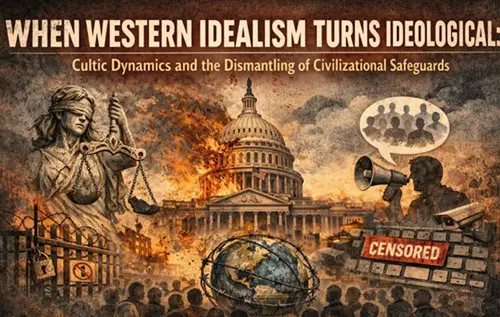 Frank Visser's essay, “When Idealism Turns Deadly,” analyzes how spiritual and moral idealism, when insulated from reality testing, can mutate into authoritarianism, groupthink, and ultimately collective self-destruction. Although Visser focuses primarily on religious and spiritual movements, the dynamics he identifies scale beyond isolated communities. They can also emerge at the level of entire civilizations when ideals harden into ideology and corrective safeguards are systematically removed.[1] This essay is intended as a companion reflection to Visser's excellent essay. His analysis of how moral and spiritual idealism can devolve into authoritarian, cult-like dynamics provides a powerful psychological and sociological framework. The present essay extends that framework beyond spiritual movements to examine whether similar dynamics are now visible at the level of Western civilization itself. Rather than disputing Visser's conclusions, this contribution asks a parallel question: what happens when the same mechanisms he identifies, ideological closure, suppression of dissent, erosion of safeguards, and insulation from corrective feedback, emerge within political, media, academic, and economic institutions? The intent is to explore continuity of pattern across scales, not to assign partisan blame or to diminish the value of Western ideals or to imply that non-Western countries are somehow immune to these problems, but to examine how those ideals may become self-undermining when detached from pluralism, accountability, and humility. The contemporary West increasingly exhibits precisely these dynamics. The issue is not the presence of ideals, since every viable civilization requires them, but the transformation of idealism into an ideological system that suppresses dissent, dismantles feedback mechanisms, and rewards conformity over truth-seeking. Idealism and Ideology: A Structural DistinctionIdealism, at its healthiest, is aspirational and provisional. It acknowledges human fallibility and therefore relies on pluralism, education, institutional checks, and open inquiry. Ideology, by contrast, absolutizes values, immunizes them against criticism, and treats dissent as moral failure rather than as a source of correction. In the West today, ideals such as democracy, human rights, and progress increasingly function less as guiding aspirations and more as identity-defining dogmas. Once this transition occurs, disagreement is no longer debated but disciplined. As Visser notes in his analysis of regressive movements, moral certainty combined with insulation from criticism is a reliable precursor to authoritarian dynamics. While we may be able to see these tendencies toward self-destructive ideological rigidity, it can be much more difficult to see them in the socio-cultural contexts which are fundamental to our identity. The Systematic Removal of SafeguardsWhat distinguishes the current moment is not hypocrisy, something common to all empires, but the erosion of institutions designed to prevent ideological capture. 1. Decline of Academic Freedom and Critical ThinkingUniversities historically functioned as centers of disciplined dissent. That role is now under strain. In 2025, Scholars at Risk documented roughly 40 attacks on academic freedom in the United States in a single year, including revocation of research funding, political interference in admissions and hiring, cancellation of lectures, and detention or attempted deportation of foreign scholars for political reasons.[2, 3] Federal pressure on universities has intensified. Columbia University, for example, agreed to significant internal policy changes following threats to withdraw approximately $400 million in federal research funding, raising concerns that financial coercion is replacing institutional autonomy.[4] These pressures create an environment where intellectual survival depends less on rigorous inquiry than on ideological alignment, weakening the capacity for critical thinking across society. When a society suppresses critical thinking it shuts out a fundamental mechanism of adaptational feedback. The result is growing rigidity and insulation from necessary information. 2. Barriers to Education and Intellectual AccessSimultaneously, higher education has become increasingly inaccessible. Rising tuition, declining public investment, and the casualization of academic labor have transformed universities into risk-averse credentialing systems in which students are one profit center among many rather than engines of independent thought.[5] The result is a population trained to perform moral alignment rather than to evaluate evidence, a condition Visser identifies as fertile ground for ideological regression. 3. Suppression of Dissent Through Informal SanctionsDissent in the contemporary West is not typically criminalized outright; instead, it is structurally punished. Deplatforming, professional blacklisting, and social shaming function as enforcement mechanisms that operate without due process. Legal scrutiny of this phenomenon has increased. In Murthy v. Missouri, a federal court found that U.S. government agencies had likely pressured social-media companies to suppress lawful speech, describing the conduct as an unprecedented assault on First Amendment protections.[6] While framed as public safety or misinformation control, such practices mirror the information management strategies Visser describes in closed belief systems: external critique is reframed as harm. Media as Echo Chamber and Bias AmplifierWestern media increasingly operates as a self-referential system. Narrative convergence across outlets, reliance on official sources, and the amplification of emotionally charged framing reinforce confirmation bias and suppress nuance. Empirical research on media ecosystems demonstrates that echo-chamber dynamics intensify polarization and reduce exposure to countervailing viewpoints.[7] Rather than functioning as a corrective feedback mechanism, media increasingly enforces group consensus, precisely the dynamic that accelerates ideological closure in cultic systems. Power Without AccountabilityAnother hallmark of regressive movements is the concentration of power without effective oversight. In the West, enforcement against elite corruption has weakened, while regulatory mechanisms have eroded. Accountability increasingly depends on individual discretion rather than institutional constraint. When governance rests on personal conscience rather than robust checks and balances, societies drift toward charismatic or arbitrary authority, both of which exist in stark immediacy today in the Presidency of the U.S. This is another pattern Visser identifies as central to group collapse. Isolation and the Severing of External FeedbackHealthy systems maintain external feedback loops. Yet Western diplomacy increasingly emphasizes moral absolutism over pragmatic engagement, reducing dialogue with perceived adversaries and narrowing informational input. Closed systems, whether spiritual communes or geopolitical blocs, tend to interpret external critique as hostility. Over time, this isolation amplifies internal certainty while degrading strategic adaptability. Why These Patterns PersistVisser emphasizes that regressive dynamics persist not because participants are irrational, but because exit becomes too costly. In the contemporary West, deviation from dominant narratives carries tangible career, financial, and social penalties. These pressures incentivize silence, conformity, and self-censorship. As documented in analyses of corporate and institutional behavior, systems that reward sociopathic or exploitative traits will reliably select for them. Once established, such systems resist reform from within. A Civilizational QuestionCritiquing Western dysfunction does not imply that non-Western societies are immune to similar pathologies. That comparison is a separate discussion. To deflect criticism outward is to avoid responsibility for what our own civilization is doing, and failing to correct. The question Visser implicitly raises, and which the West must now confront, is unavoidable: Why should Western societies expect to escape the fate of religious cults when they increasingly adopt the same dysfunctional practices, suppressing dissent, dismantling safeguards, and rewarding ideological conformity over truth? Civilizations do not collapse for lack of ideals. They collapse when ideals are mistaken for infallibility. In the context of Integral AQAL, when UL intent and consciousness and LL values take precedence over objective evidence and collective justice the result is a failure to tetra-mesh. When the imbalance becomes chronic there is a predictable systemic collapse back to a more stable level of organization. That collapse, often experienced as regression and as painful psychologically, emotionally, physically, culturally, and socially, can be avoided if we not only recognize its causes but take steps to require both responsibility and accountability. Notes1. Frank Visser, When Idealism Turns Deadly, Integral World, 2026. 2. Scholars at Risk, “Attacks on Academic Freedom in the United States, 2025.” 3. “Unprecedented in History: Scholars at Risk Reports 40 Attacks on U.S. Academic Freedom in 2025,” Khaama Press, 2025. 4. Washington Post, “Fallout From Columbia's Capitulation Fuels Fears About Academic Freedom,” March 24, 2025. 5. American Federation of Teachers, “The Crisis in Higher Education and Academic Freedom,” 2025. 6. Murthy v. Missouri, U.S. District Court findings, 2023-2024. 7. Research on media echo chambers and polarization, e.g., arXiv:2103.10979.
Comment Form is loading comments...
|