|
TRANSLATE THIS ARTICLE
Integral World: Exploring Theories of Everything
An independent forum for a critical discussion of the integral philosophy of Ken Wilber
 Joe Corbett has been living in Shanghai and Beijing since 2001. He has taught at American and Chinese universities using the AQAL model as an analytical tool in Western Literature, Sociology and Anthropology, Environmental Science, and Communications. He has a BA in Philosophy and Religion as well as an MA in Interdisciplinary Social Science, and did his PhD work on modern and postmodern discourses of self-development, all at public universities in San Francisco and Los Angeles, California. He can be reached at oversoul2001@yahoo.com. Joe Corbett has been living in Shanghai and Beijing since 2001. He has taught at American and Chinese universities using the AQAL model as an analytical tool in Western Literature, Sociology and Anthropology, Environmental Science, and Communications. He has a BA in Philosophy and Religion as well as an MA in Interdisciplinary Social Science, and did his PhD work on modern and postmodern discourses of self-development, all at public universities in San Francisco and Los Angeles, California. He can be reached at oversoul2001@yahoo.com.
SEE MORE ESSAYS WRITTEN BY JOE CORBETT
Spiritual Technologies of the SelfEast and WestJoe Corbett / ChatGPT
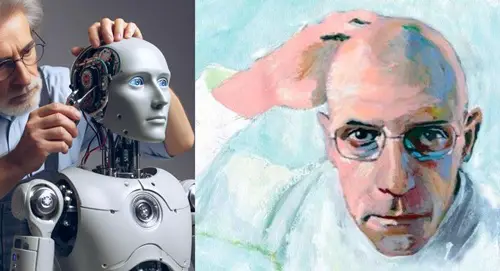 Ethical Practices of the Self Across TraditionsAcross cultures and epochs, people have undertaken varied practices aimed at forming, refining, and sometimes transforming the self. These technologies of the self—whether framed as virtue, devotion, knowledge, or nondual realization—seek to regulate attention, discipline desire, cultivate understanding, and orient action toward a larger aim such as the good, the holy, or the true. What counts as a meaningful end and what counts as an effective method differ, but a common thread runs through many traditions: the ordinary person is pressed to work on themselves, not as a mere byproduct of social life but as a constitutive project of meaning, self-identity, responsibility, and intelligibility—a veritable aesthetics of cosmic self-creation. The practices of the Stoics foreground reason, virtue, and resilience as the core aims of ethical life. Central to their program is the conviction that only virtue is truly good and that externals—wealth, status, comfort, even health—are preferred or tolerated only insofar as they serve a life governed by rational judgment. The method is a disciplined training of the self to align desire with nature, to govern impressions, and to exercise moral steadiness in the face of fortune. Prohairesis, the faculty of moral choice, becomes the crucial interior locus of control, while the daily exercises—negative visualization, reflection on one's judgments, preparation for possible misfortune, and evening recollection—provide a scaffold for steadiness, clarity, and equanimity. The purpose is not self-indulgence but the achievement of ataraxia, a tranquil liberty that arises from living consistently with reason and the universal order. Meaning, in this framework, is found in the cultivation of a rational stance toward life, a stance that dignifies the human as a rational animal capable of choosing how to respond to events rather than being moved mindlessly by them. The self, thus, is forged through habit and judgment, and its worth is measured by how well it sustains virtue under pressure. In early and later Christianity, the self is shaped through practices of prayer, discipline, and confession, with an arc that moves from interior devotion toward the formation of knowledge, authority, and method. Early Christian life places a premium on prayer as a direct, ongoing conversation with God, a pedagogy of the heart that seeks to align the believer's will with divine intention. Monastic and contemplative traditions extend this inward work into communities of discipline, fasting, vigil, and liturgical prayer, where the self learns to endure and to transcend mere appetite in service of a larger good. Confession—first as a penitential practice and later as a sacramental obligation—institutionalizes a public dimension of inward life: sins are named, accountability is established, and moral discourse becomes a practice that binds the self to a community of moral memory. The moral economy here is relational and teleological: the self is trained to be truthful before God and neighbor, to confess weaknesses, and to seek transformation through grace and communal support. This Christian grammar of selfhood has a consequential lineage that some scholars trace toward the emergence of modern epistemic confidence and empirical inquiry. In Augustine and other early writers, interior examination and the flexibility of conscience are linked to ongoing interpretive work with texts and tradition. In later centuries, the didactic and ascetic disciplines of the Christian East and West exercise a kind of rational discipline that can resemble a proto-scientific habit of self-skepticism and systematic inquiry. When thinkers such as Descartes appear, a line is often drawn from the Christian culture of self-scrutiny to the modern figure of the scientist who doubts, interrogates, and rebuilds knowledge from foundational propositions. Descartes' method of doubt, famously solitary and universal, echoes the Christian conviction that certainty must meet the test of rigorous scrutiny, even if the underlying teleology shifts—from salvation and worship to knowledge, demonstration, and the intelligibility of the natural world. The scientific method, then, can be read as an extension or secularization of a long Christian tradition of disciplined self-inquiry, where the self becomes the instrument of inquiry and the environment becomes a test bed for durable truths. Eastern traditions broaden the horizon of ethical self-cultivation with distinct metaphysical commitments and practical modalities. Tibetan Buddhism emphasizes the transformation of mind through a structured program of meditation, ethics, and devotion. Shamatha, or calm-abiding meditation, cultivates steadiness of attention, while Vipashyana or insight practice deepens discernment into the nature of mind and phenomena. The Mahayana ethos of the bodhisattva path adds the dimension of compassion and the vow to liberate all beings, which reframes self-cultivation as inseparable from altruistic intention. Mind training (lojong) and tantric practices further elaborate techniques for transforming affect, perception, and identity, guiding the practitioner toward a non-dual appreciation of interdependence and emptiness. Here the self is not a fixed essence to be strengthened but a process of awakening in which the sense of a separate, enduring ego is gradually deconstructed and reconstituted within a wider, luminous field of awareness. Meaning arises, then, in the unfolding realization that freedom from suffering is not a solitary achievement but a relational embodiment of wisdom and compassion. Kashmiri Shaivism offers another powerful articulation of self-cultivation grounded in nonduality and the recognition of the true nature of reality. In the pratyabhijña tradition, knowledge of who one truly is—recognition of the innermost Self as Shiva—orients ethical life toward an immediate, experiential realization of consciousness as the sole reality. The practices are rich with yogic and contemplative techniques, including meditation on the nondual unity of subject and object, contemplation on the inherent consciousness of all experiences, and the cultivation of an engaged, transformative awareness that reframes ordinary perception as a manifestation of divine play (lila). Rather than aspiring to control external circumstances, Kashmiri Shaivism emphasizes recognizing the pre-existing divinity within all phenomena and living from that recognition. The ethical aim is the dissolution of false boundaries between self and world, enabling a life of spontaneity, devotion, and responsible action aligned with universal consciousness. The self, in this tradition, is not merely disciplined but awakened into a reality in which the ordinary and the sacred are inseparable. If one reads these traditions together, a set of shared concerns emerges even as each tradition enacts them through different metaphysical vocabularies. All seek to modify the practitioner's relation to desire, fear, time, and others. All propose practices aimed at displacing passive reactivity with reflective action, at transforming self-concerns into obligations toward something larger than the self, and at turning inner dispositions into outward forms of conduct that bear ethical meaning. Yet they diverge in their theorization of the self's ultimate nature and the telos of transformation: virtue and tranquil freedom for the Stoics; communion with grace for Christian traditions; the awakening of mind and compassion for Buddhism; and the realization of nondual consciousness for Kashmir Shaivism. These differences matter for how power, knowledge, and authority enter the work of self-formation in each tradition, shaping what counts as legitimate self-work and what counts as authentic selfhood. Foucault's gaze on these technologies of the self invites us to see them as historical practices shaped by power, discourse, and institutional arrangements as well as by intimate aims of virtue, salvation, or enlightenment. For Foucault, the self is not an inner essence but an effect of practices—disciplines, rituals, exhortations, confessions, and contemplative trainings—that produce particular kinds of subjects and ways of knowing. The Stoic regimen can be read as a technology of the self that fosters a disciplined, autonomous agent capable of resisting the sway of fortune; it cultivates a certain self-reliance that emerges through habituation and rational adjudication of impressions. In this sense, Stoicism aligns with Foucault's interest in how individuals govern themselves to inhabit a morally intelligible life, albeit within a framework that places rational nature and cosmic order as the ultimate authorities. Christian prayer and confession likewise function as technologies of the self embedded in ecclesial power and truth regimes. Confession structures the self as accountable before a divine order and a religious community, shaping what counts as knowledge about oneself and what counts as evidence of moral truth. The discipline of confession, penitential practice, and liturgical life contribute to a mode of self-government in which truth-telling about oneself is both a moral obligation and a route to transformation. From a Foucauldian perspective, such practices not only cultivate virtue or salvation but also produce particular forms of subjectivity—pious, repentant, morally legible to others within a Christian social field. The later turn toward modern science adds another layer: the rationalization of doubt, the insistence on repeatable methods, and the habit of hypothesis testing can be seen as secularized forms of the old self-scrutiny that prayer and confession once demanded, with the laboratory replacing the cloister and the scientist becoming a kind of modern confessor of nature. Eastern meditative traditions present yet different technologies of the self, often more explicitly oriented toward a deconstruction or reconfiguration of the sense of self itself. Tibetan Buddhist practices cultivate attentional training, ethical intention, and wisdom as a path from grasping to non-attachment. The self-as-centered agent is gradually seen as provisional, with identity and phenomena understood through the lens of interdependence and emptiness. This can be read as a powerful form of self-constitution that distributes power away from a singular ego toward a fluid field of awareness and responsibility. Kashmiri Shaivism offers a corresponding but distinct technology—recognition of the true Self as nondual, conscious unity with the divine, and the cultivation of right perception that dissolves dualistic boundaries. Here the self is neither anchored in willpower nor dissolved in total negation but awakened into a direct, experiential knowing of its inseparability from all that appears. In Foucault's terms, these practices operate as modalities of subject-formation embedded in ritual, pedagogy, and guru-disciple relations, producing subjects governed by attentional, ethical, and experiential norms that legitimate particular ways of being in the world. Placed side by side, these modalities reveal both continuities and differences in how cultures modulate the self. A common concern is governance—how to regulate desire, attention, and action so that life becomes meaningful within a given ethical horizon. A shared concern is transparency toward effects of one's own conduct—self-examination, self-scrutiny, and accountability to a larger order. Yet the sources of authority differ: rational nature and the cosmos for the Stoics; divine grace and ecclesial authority for Christian practice; mind and compassion for Buddhist paths; consciousness and recognition of the divine for Kashmir Shaivism. Each tradition deploys a different apparatus—inner dialogue, confession, contemplative absorption, or recognition—to yield a self that is coherent with its metaphysical commitments. And each acts within networks of power and knowledge—schools, monasteries, lay associations, lineages, and communities—that shape what counts as authentic self-work and what counts as credible tellings of the self. To think about these practices through the lens of Michel Foucault's technologies of the self is to see them not as mere personal preferences but as historically situated interventions that configure what counts as a good life. They are not simply appeals to virtue or improvement; they are technologies that create subjects capable of acting in particular ways within particular social and epistemic orders. The Stoic exercises train a citizen of the world to bear fortune with equanimity; Christian practices embed ethical life within a fealty to God, community, and truth; Tibetan and Kashmiri traditions train ways of inhabiting mind and reality that reframe what counts as real and what it means to be a knowing agent. Each tradition offers tools for self-fashioning that can liberate, constrain, or reorient according to what their cultures prize as the ultimate good. In the end, the study of these diverse technologies of the self invites a reflective humility: we may learn from others' methods of becoming, while remaining attentive to how our own frameworks of power, knowledge, and value shape the very question of what it means to live as an act of self-creation within the larger cosmos.
|